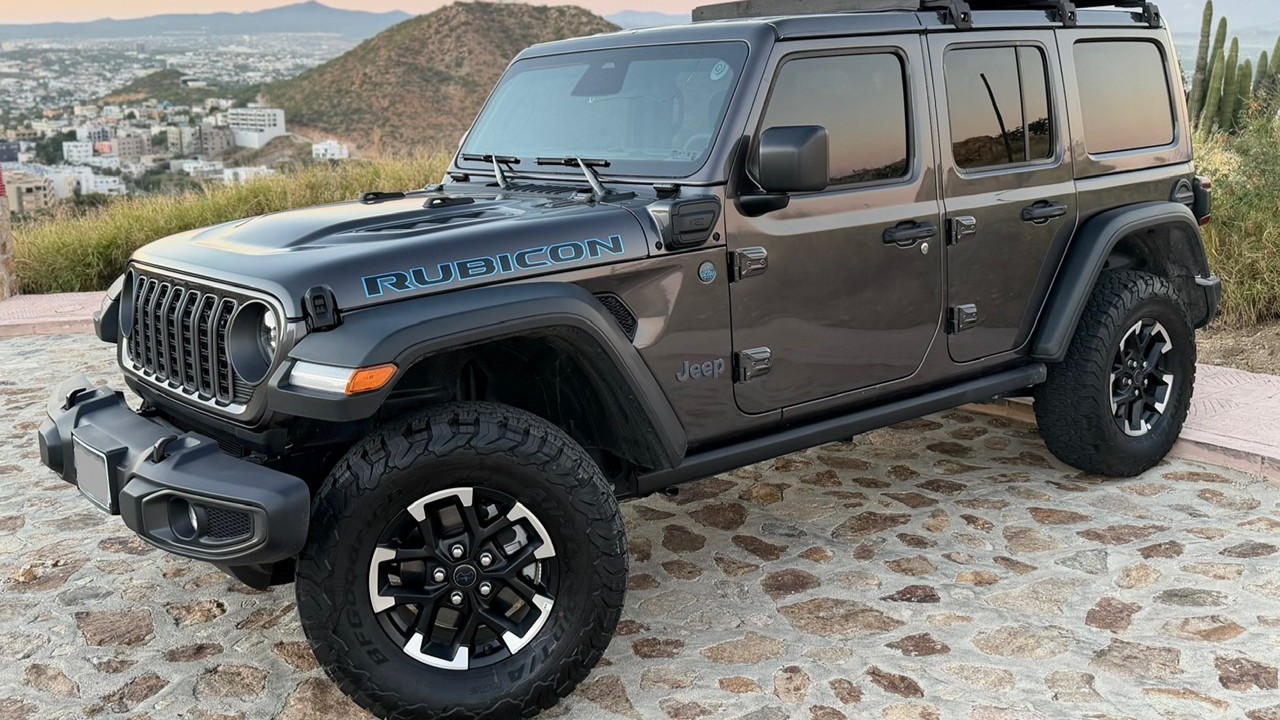
Your 4xe loses drive power and reads "Electric Mode Temporarily Unavailable" while you're driving.
It happens during normal driving, without warning: electric propulsion is cut in stages, the dash throws an amber message, and for a few seconds the accelerator does almost nothing before the gas engine catches. Dealers scan it, find no codes, and call it normal. This page documents what is actually happening — and the one report that regulators count.
~10 min · free · the report regulators actually count
LIVE DATA — PROPULSION EVENTFAULT CONDITION ACTIVE
ELECTRIC PWR LIMIT · STAGE 150%
ELECTRIC PWR LIMIT · STAGE 225%
ELECTRIC DRIVEDISABLED
DASH MESSAGEELECTRIC MODE TEMPORARILY UNAVAILABLE
DTC / FAULT CODE STOREDNONE
MFR DETERMINATION"OPERATING AS DESIGNED"
SRC: OWNER-DOCUMENTED EVENTSTATUS: UNRESOLVED
Owner video — caught on camera
Watch a Jeep Wrangler 4xe lose electric power during normal driving
Owner-recorded · the 4xe instrument cluster during the staged power loss.
Is your Jeep Wrangler 4xe losing electric power while driving? This is an owner recording of the 4xe unexpectedly reducing power — the staged "derate" where electric drive drops to 50%, then 25%, then displays "Electric Mode Temporarily Unavailable" and forces the Jeep into hybrid. If your 4xe does this cascade reduction of power during normal driving, you are seeing the same thing documented across this site.
The staged power loss is not a part failing. It is a protective software limit doing exactly what it was written to do.
Owners and independent research point to a software strategy that caps how much the electric side will deliver and shifts the load to the gas engine — reportedly to protect the high-voltage battery. Because that limiting is intentional, programmed behavior rather than a malfunction, it does not set a diagnostic trouble code. That single fact explains the entire pattern.
When a dealer connects a scanner and finds "no codes," the conclusion becomes "nothing is wrong." But a protective strategy running as written is supposed to be silent. "No codes" tells you the software is behaving as programmed — not that the behavior is safe, and not that the threshold that triggers it is correct. So "no codes" proves nothing, and it is why every dealer visit ends the same way: "operating as designed."
It is also not driver error. In at least one documented case, a dealership reproduced the same behavior on a second, different 4xe pulled from its own lot. Owners across different states and model years report the same sequence.
Search match
If you searched "4xe loses power", "4xe won't accelerate", or "Electric Mode Temporarily Unavailable" — this is the page you were looking for. You are not imagining it, and you are not the only one.
Readout 02
Signature sequence
The same staged drop, captured on the dashboard during a single drive. Electric power is halved, then quartered, then disabled — followed by the message and a forced handoff to the gas engine.
STAGE 1
50%
Electric power limited by half
→
STAGE 2
25%
Cut again to about a quarter
→
STAGE 3
0%
Electric drive disabled mid-drive
→
RESULT
"Electric Mode Temporarily Unavailable"
Forced into hybrid after a delay
Readout 03
What they say vs. what they don't say
Every statement in the left column is accurate on its own. The right column is what those statements leave out.
What is said
"No codes found."
"Operating as designed."
"It still runs in gas — not serious."
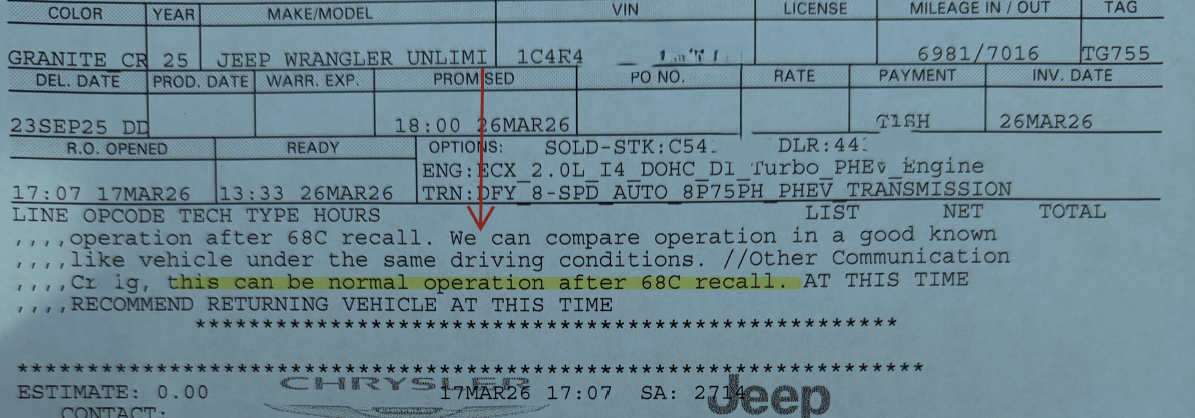
"Normal after the 68C recall."
What is not said
A protective limit is built specifically not to set a code — so "no codes" is expected, not reassuring.
"As designed" describes a design that was changed by a recall after purchase, not the vehicle as originally sold.
Nobody measured the battery, coolant, or motor temperatures during an actual event.
A dealer refused to road-test and log those temperatures unless the owner paid out of pocket.
A loss of motive power is dangerous — by the manufacturer's own standard.
In its federal safety recall filings, the manufacturer has stated that a loss of motive power can cause a crash without warning — serious enough to warrant a recall. By that same standard, the same outcome cannot be a safety defect in one case and "normal operation" in another. A loss of drive power is defined by what happens to the driver, not by which component — or which software update — caused it.
The hazard is the delay between asking for power and getting it. When you press the accelerator to merge onto a highway, cross an intersection, or pull into a gap in traffic, a few seconds of little-to-no response is exactly when you can least afford it. That is the gap owners are documenting, and it is what an NHTSA report puts on the record.
The reasonable response
It is not a label — it is a measurement: drive the vehicle until it loses power, log the conditions, and identify what triggers the cut. A manufacturer confident the vehicle is operating correctly has no reason to refuse that measurement.
What this means for a vehicle that isn't on the list
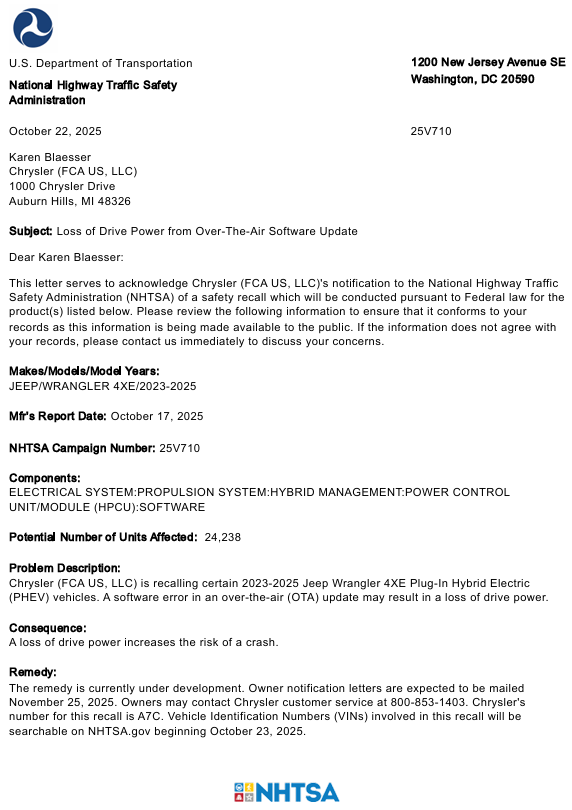
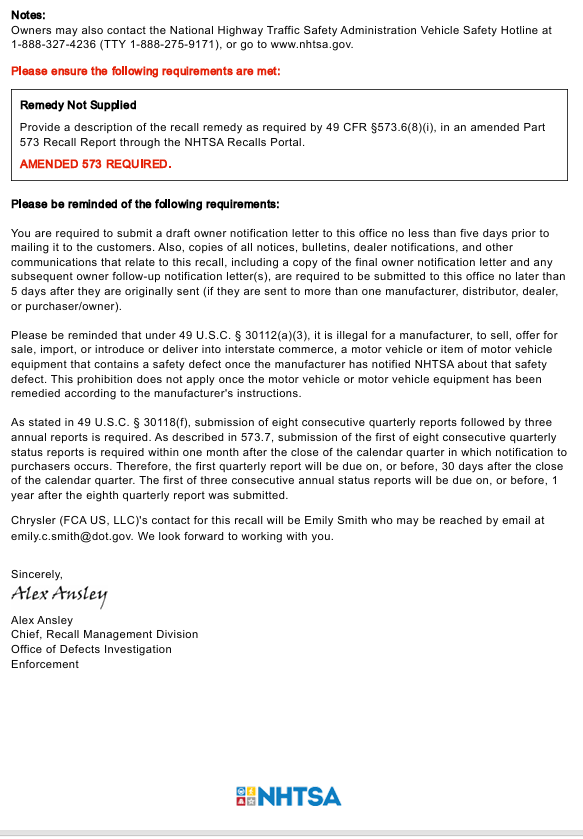
This vehicle fits the recall's description — but is not in its population.
The recall covers "certain" 2023–2025 Jeep Wrangler 4xe vehicles — 24,238 of them. This owner's 2025 Wrangler 4xe is not among the VINs listed in the A7C recall; a NHTSA VIN search shows no open recall on this vehicle. Yet the vehicle exhibits exactly what the recall describes: loss of drive power. That raises fair questions this owner cannot answer alone:
If the vehicle experiences the same loss of drive power the recall was issued for, why is it not in the recall population?
Was this VIN missed?
How many other 4xe vehicles experiencing loss of drive power were also left out?
The only way to answer these questions is for the dealer and the manufacturer to investigate — to drive the vehicle, measure the conditions during an event, and determine whether it shares the defect the recall identifies. That is the cooperation this owner has requested and not received.
The manufacturer has formally told the federal government that a software error can cause loss of drive power in these vehicles, and that loss of drive power increases crash risk. A vehicle showing that same failure should be investigated against that recall — not dismissed as "operating as designed."
Note. The recall describes the cause only as "a software error in an over-the-air (OTA) update may result in a loss of drive power"; it does not specify the exact failure mode. This section does not assert that this vehicle has the A7C defect — only that a vehicle exhibiting the same loss of drive power should be checked against the recall rather than dismissed.
The vehicle isn't operating as designed — it's operating outside its own published specification.
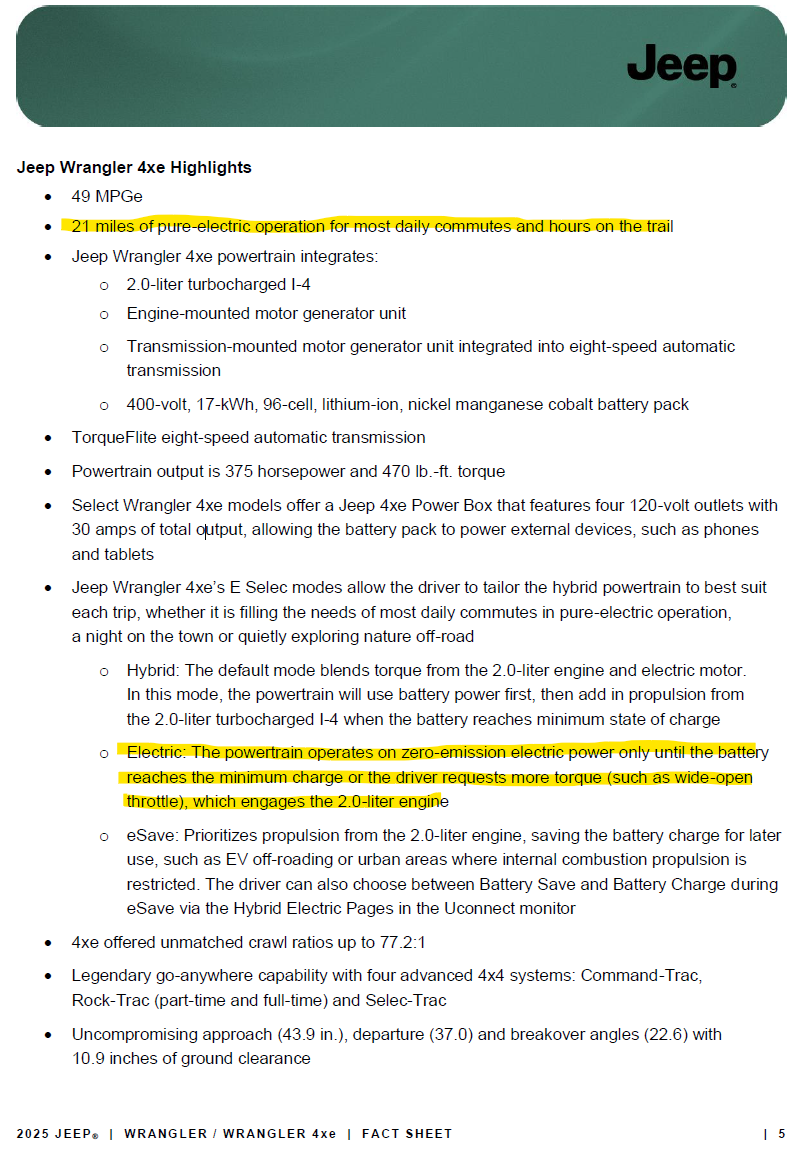
Jeep publishes, on one page, both what the 4xe was sold to do and the exact conditions under which its engine is supposed to engage. That page anchors this section.
Marketed capability · 2025 Wrangler 4xe Fact Sheet21 miles of pure-electric operation for most daily commutes and hours on the trail.
Operating specification · 2025 Wrangler 4xe Fact SheetElectric: The powertrain operates on zero-emission electric power only until the battery reaches the minimum charge or the driver requests more torque (such as wide-open throttle), which engages the 2.0-liter engine.
On a single page of Jeep's own fact sheet, the marketed capability and the operating specification appear together.
Expected
21 miles of pure-electric operation, with the gas engine engaging only when the battery reaches minimum charge or the driver requests wide-open throttle. Those are the only two conditions the specification lists.
What owners experience
electric power is reduced — to roughly 50%, then 25% — then disabled entirely, at 41%, 73%, and 81% state of charge during normal driving, with no wide-open-throttle request. None of those is minimum charge, and none involved wide-open throttle. The vehicle engages the engine and disables electric drive under conditions the specification does not list.
Three pages of Jeep's own Owner Handbook describe what the vehicle is designed to do — and the single condition under which electric drive is expected to be unavailable. Each page is reproduced below, with the expected behavior set against what owners actually experience.
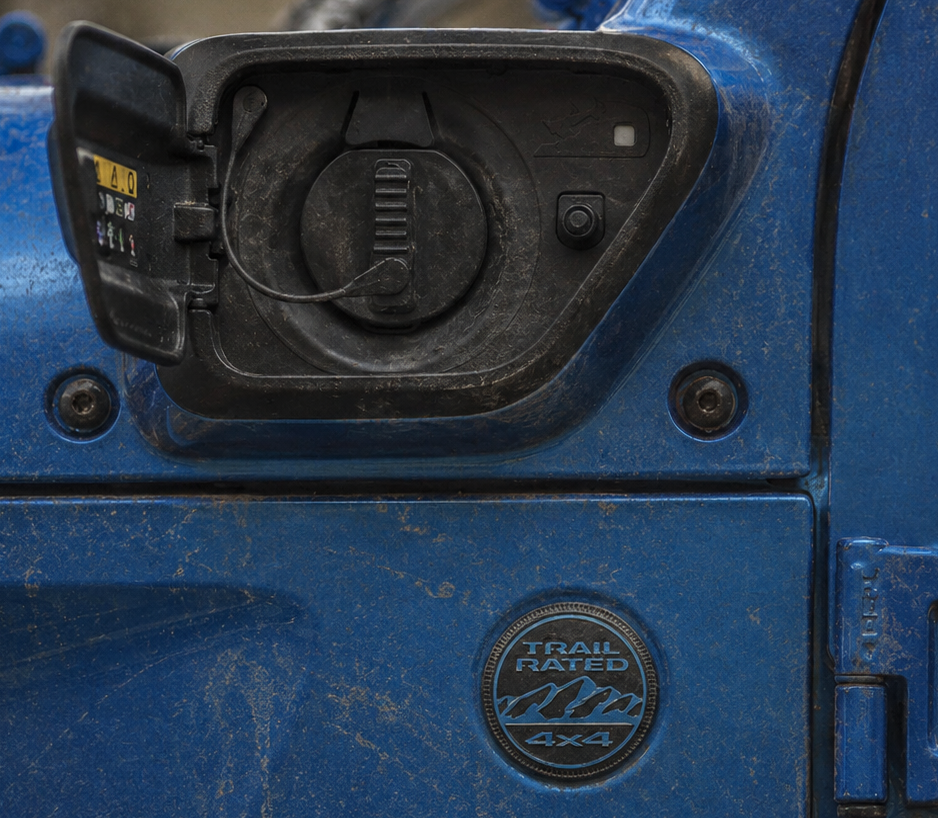
The Jeep Wrangler 4xe charge port. The 4xe is a plug-in hybrid electric vehicle (PHEV) designed to be charged and driven on electric power — the capability owners report losing when the vehicle unexpectedly reduces power and displays "Electric Mode Temporarily Unavailable."
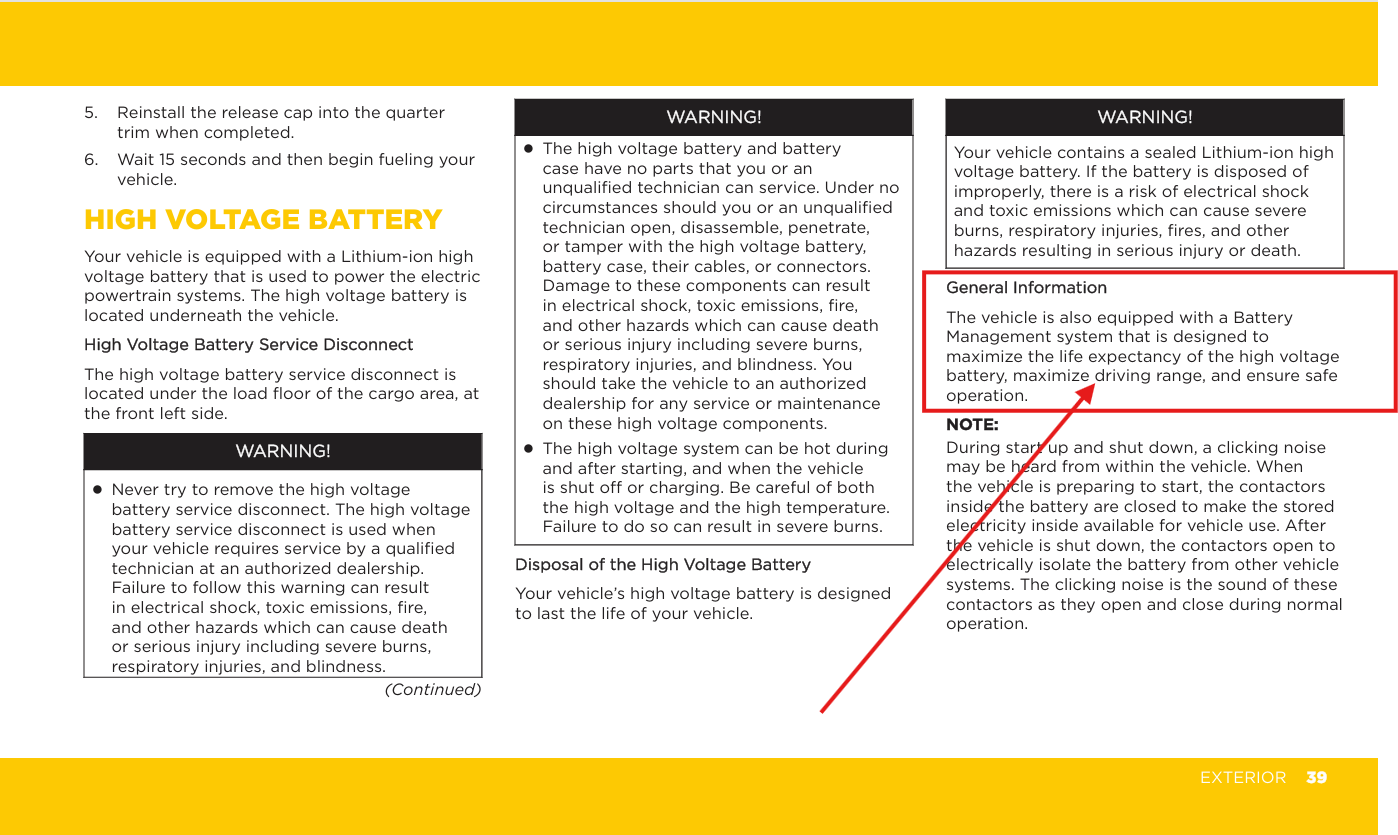
Design intent: maximize range and ensure safe operation
2025 Jeep Wrangler Owner Handbook, page 39.
This is the manufacturer's own statement of what the high-voltage battery system is designed to do. Page 39 of the 2025 Jeep Wrangler Owner Handbook states the Battery Management system is designed to "maximize the life expectancy of the high voltage battery, maximize driving range, and ensure safe operation."
Expected
the system maximizes driving range and ensures safe operation.
What owners experience
electric propulsion is reduced and then disabled during normal driving — the opposite of maximizing range. Reducing propulsion, limiting acceleration, or disabling electric drive appears nowhere among the stated design objectives.
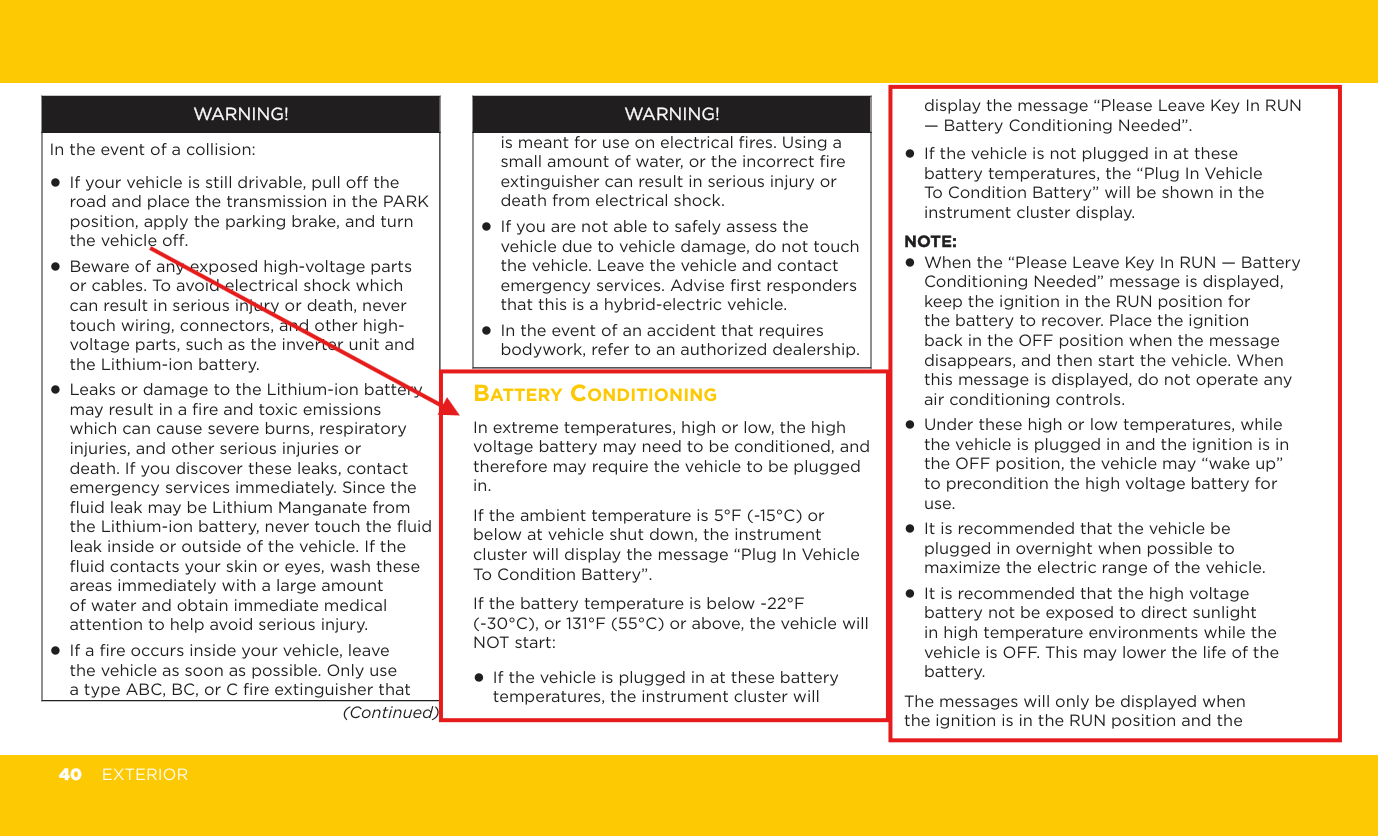
The only documented condition for limited electric operation: extreme temperature
2025 Jeep Wrangler Owner Handbook, page 40.
Page 40 documents the one circumstance in which the manual says electric operation is affected or the vehicle will not start: extreme battery temperature — below -22°F (-30°C) or above 131°F (55°C). The same page recommends plugging in overnight "to maximize the electric range of the vehicle."
Expected
electric is only unavailable at temperature extremes far outside normal driving; owners are directed to maximize electric range.
What owners experience
power loss in ordinary conditions — moderate temperatures, mid-range charge — a situation this section does not describe. The manual's documented cause for unavailable electric operation (extreme temperature) does not match what owners are experiencing.
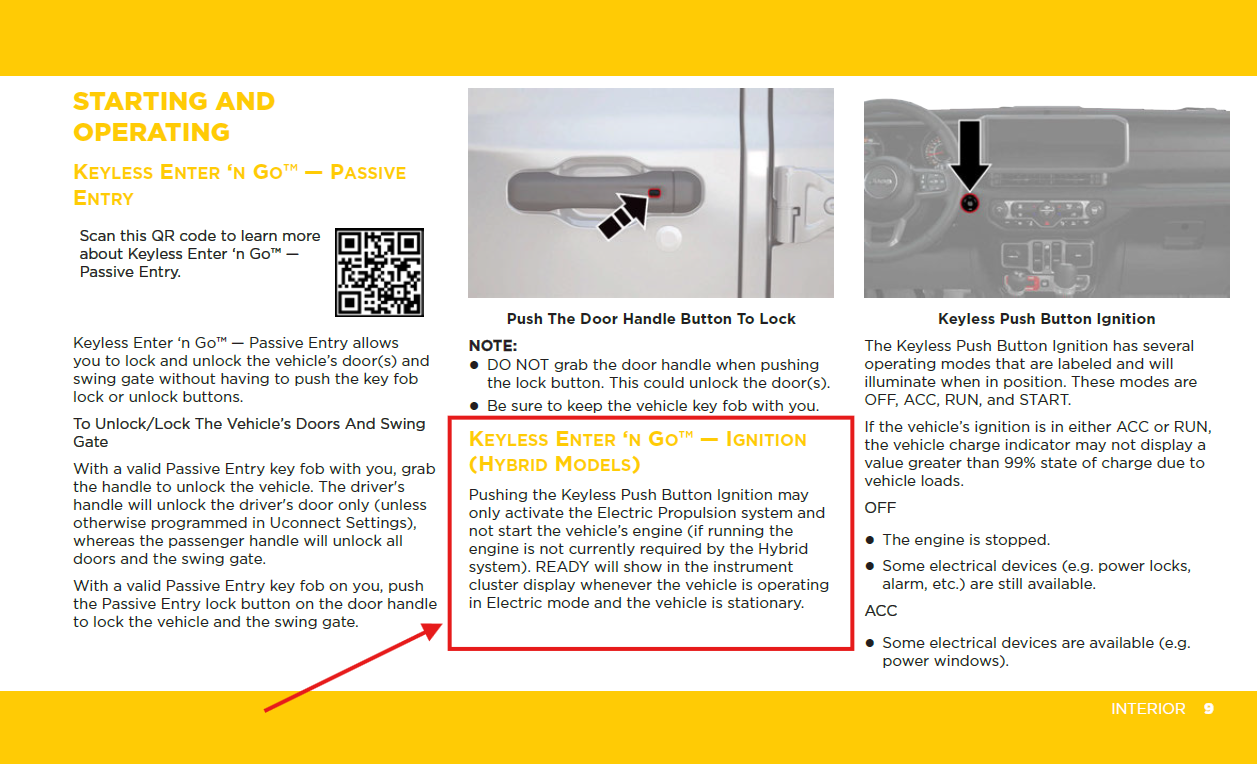
Electric propulsion is a normal operating mode
2025 Jeep Wrangler Owner Handbook, page 9.
Page 9 describes the hybrid ignition: pushing the ignition "may only activate the Electric Propulsion system and not start the vehicle's engine," and "READY will show in the instrument cluster display whenever the vehicle is operating in Electric mode."
Expected
driving on electric power is a normal, intended operating state — not an emergency or limited mode.
What owners experience
that normal operating mode is interrupted without warning during ordinary driving, then labeled "operating as designed."
Three of the manufacturer's own documents — and they cannot all be true.
Each statement below comes from the manufacturer's own materials. Read together, they contradict each other — and the vehicle is caught in the middle.
Exhibit 1What we were soldSource · 2025 Jeep Wrangler 4xe Fact Sheet
The powertrain operates on zero-emission electric power only until the battery reaches the minimum charge or the driver requests more torque (such as wide-open throttle), which engages the 2.0-liter engine.21 miles of all-electric range and zero range anxiety.
Plain readingAs specified and marketed, electric power continues until minimum charge — or until the driver floors it. Nothing else engages the engine.
Exhibit 2What we got, after the 68C recallSource · Dealer service record, Jeep field-engineer note
this can be normal operation after 68C recall.
Plain readingAfter the 68C recall, a software change reduces and disables electric power during normal driving — at 41%, 73%, and 81% state of charge, far from minimum charge and with no wide-open throttle — and the manufacturer calls this "normal." This behavior was introduced after the vehicle was sold.
Source · Dealer service record, Jeep field-engineer note. Personal details redacted; highlighting in original.
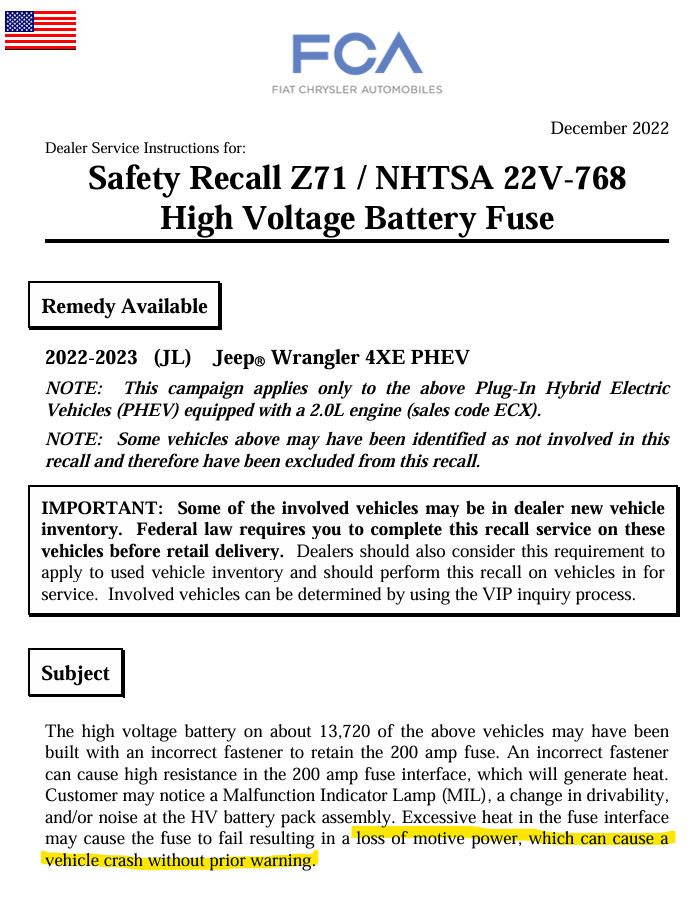
loss of motive power, which can cause a vehicle crash without prior warning.
Plain readingFCA has formally told the federal government that a sudden loss of motive power is a crash hazard — serious enough to recall vehicles over.
We were sold 21 miles of electric power that yields to the engine only at minimum charge or wide-open throttle. After the 68C recall, a software change instead reduces and cuts electric power unexpectedly, mid-charge — and that is called "normal operation." But that same outcome — a sudden loss of motive power without warning — is exactly what the manufacturer's own recall defines as a crash hazard.
It cannot be both normal and a crash hazard. It cannot be both the specified behavior and a change introduced after the sale. The one event that turned the vehicle we were sold into the vehicle we now have was the 68C recall itself.
† Recall Z71 / 22V-768 concerns a battery fuse and is a separate matter; it is cited only for the manufacturer's stated position that loss of motive power is a safety hazard.
When a manufacturer's own documents contradict each other on a safety issue, the place that record belongs is NHTSA.
The manufacturer's defense is that the gas engine eventually engages, so the driver still has power. But that misses where the hazard actually lives — in the seconds before it does.
By specification, flooring it summons the engine.
Jeep's own spec sheet says the engine engages when "the driver requests more torque (such as wide-open throttle)." Wide-open throttle is the designed way to call in the gas engine.
But the power loss is unexpected, not driver-initiated.
In the failure, the driver isn't flooring it. The software cuts electric power on its own — 50%, then 25%, then "Electric Mode Temporarily Unavailable" — while the driver is driving normally and expecting the power they had a moment earlier.
First comes the recognition gap.
The power fades, and for several seconds the driver is processing what's happening — why the vehicle is slowing, why the accelerator isn't responding — before reacting.
Then the recovery delay.
The driver floors it to force the engine in — the spec's own mechanism — but the gas engine still takes its own moment to engage and deliver torque.
The deadly window is the sum of both.
Recognition delay plus engine-engagement delay. During that window — merging, crossing an intersection, pulling into traffic — the vehicle is not delivering the power the driver is asking for.
That window — a sudden, unexpected loss of motive power without warning — is exactly what FCA's own recall (Z71 / 22V-768) describes as something that "can cause a vehicle crash without prior warning." †
The engine catching eventually does not remove the hazard. The hazard is the delay: the time to realize power is unexpectedly gone, plus the time for the engine to take over. The specification describes the recovery; it does not account for the unexpected loss that forces the driver into it — and that loss is the part the manufacturer's own recall calls a crash risk.
† Recall Z71 / 22V-768 concerns a battery fuse and is a separate matter; it is cited only for the manufacturer's stated position that loss of motive power is a safety hazard.
One documented report is how a pattern starts.
Dealers and the manufacturer can close a service ticket. They cannot close an NHTSA file. If your 4xe does this, the most useful thing you can do is put it on the federal record — clearly, factually, in about ten minutes.