Manufacturer & dealer record

What the dealer and Stellantis actually said.

Across multiple service visits, the answer was consistent — no codes, operating as designed. This page documents those responses in their own words, including the service records, the STAR case determination, and a documented refusal to put road-test findings in writing.

Everything below is presented as it appears in the record. It states what was reported, what was answered, what was requested, and what was declined — and nothing more.

Readout 01

The pattern of responses

Four touchpoints, one recurring determination. The right column quotes or closely paraphrases what was recorded or stated at each step.

Visit What was reported Dealer / Stellantis response
Service visit Limp mode / ~25% power; staged loss of electric propulsion during normal driving. "No diagnostic codes. Vehicle duplicated coming out of electric mode on its own. STAR case opened."
Second-vehicle test Whether the behavior was unique to the owner's vehicle. "A separate 4xe from dealer inventory also came out of electric mode under the same test."
STAR / Jeep engineering Determination on the reported condition. "Operating as designed. Can be normal operation after the 68C recall."
Owner request To log temperatures / parameters during an event. "Declined — would only be performed if paid out of pocket."

Readout 02

Service records

Repair orders and service records documenting the reported condition and the determinations reached. The most recent and most complete record leads; earlier records follow. Highlights in the originals were made by the owner.
Latest record · new Colorado dealer
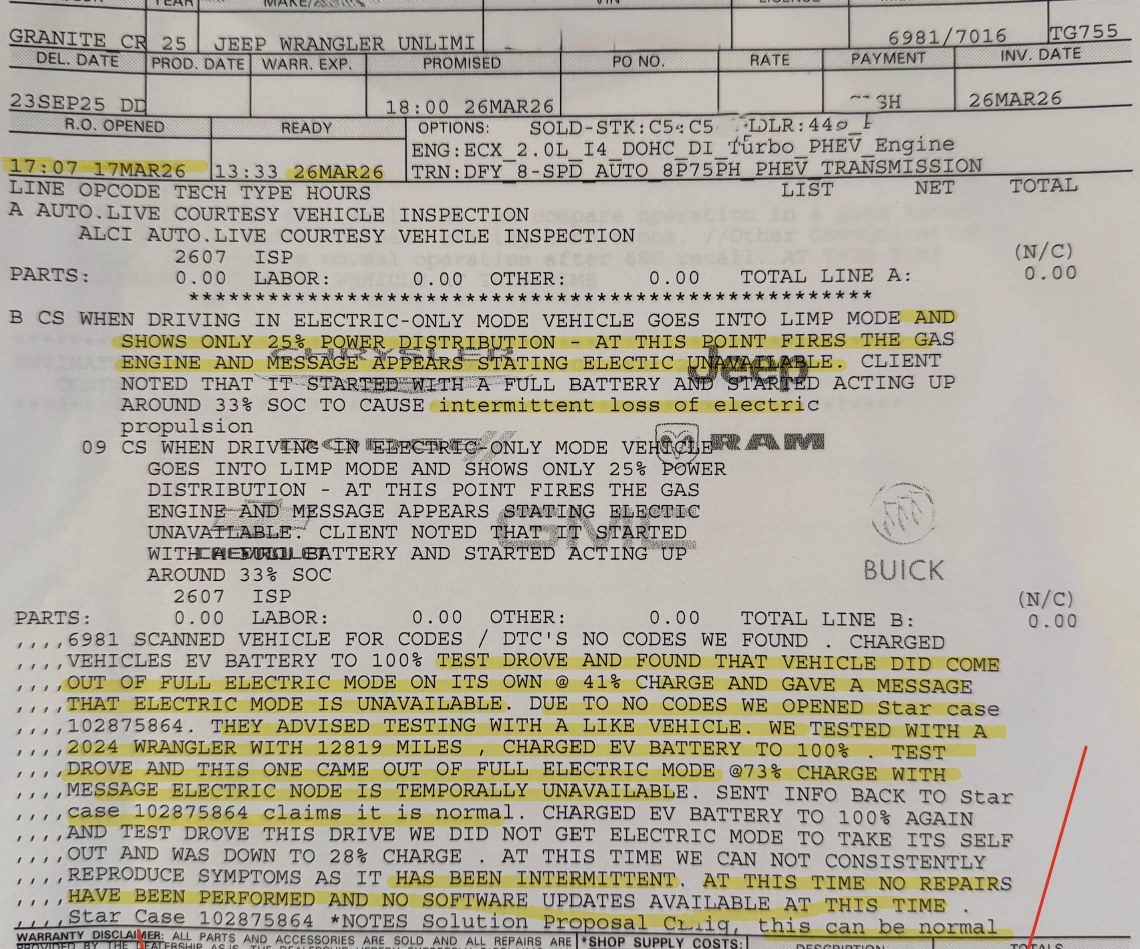
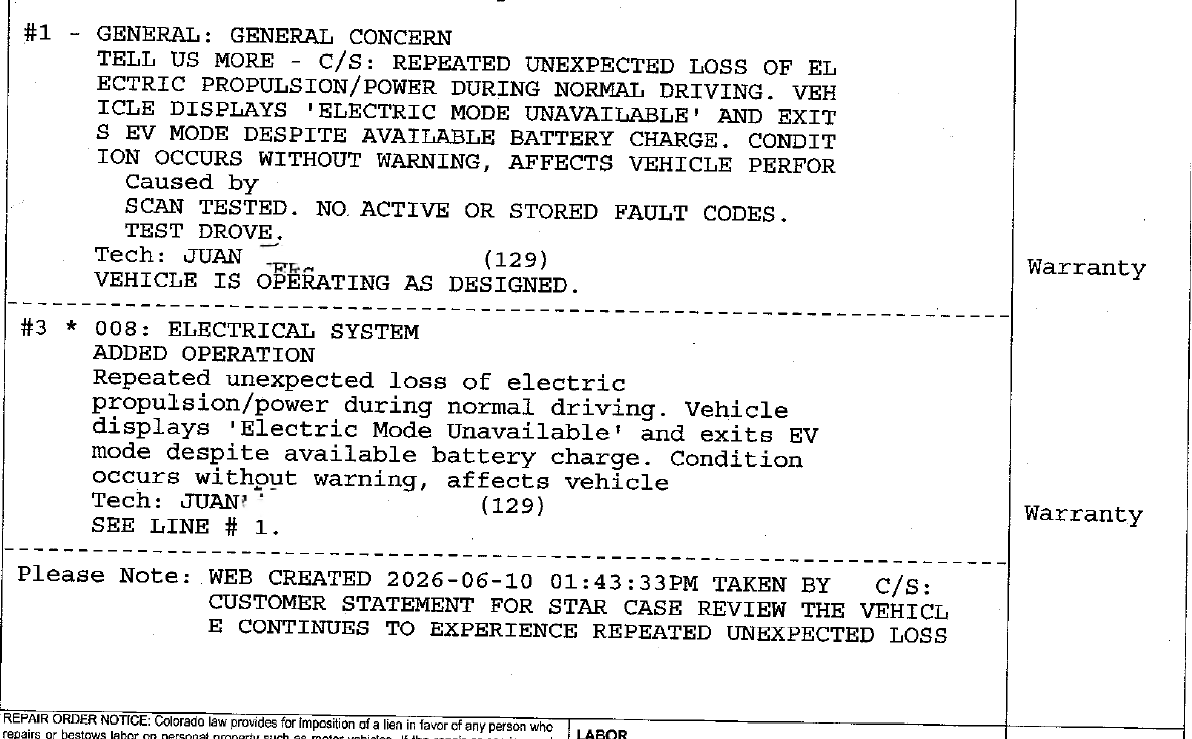
Repair order concern lines documenting repeated unexpected loss of electric propulsion during normal driving; scan tested with no fault codes; vehicle is operating as designed.
RECORD · DEALER FINDINGS
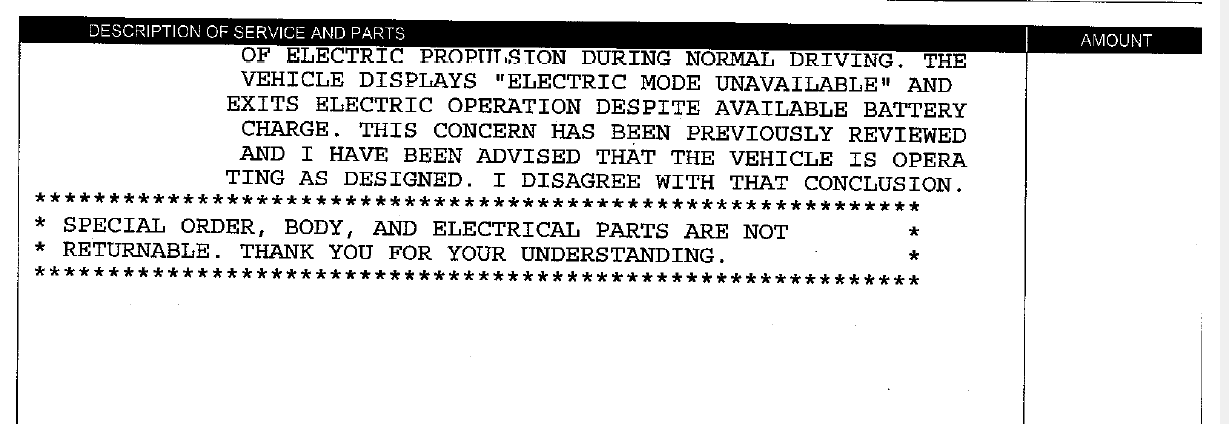
Owner's written statement on the same repair order disagreeing with the operating-as-designed conclusion.
RECORD · OWNER STATEMENT

Most recent service record (Colorado, June 2026). The dealer documented the complaint in its own words: "repeated unexpected loss of electric propulsion/power during normal driving... displays Electric Mode Unavailable... condition occurs without warning." The technician scan-tested (no active or stored fault codes), test drove, and concluded the vehicle "is operating as designed."

Dealer findings Scan tested. No active or stored fault codes. Test drove. Vehicle is operating as designed.
Owner statement · same record I disagree with that conclusion.

After the road test, the service manager called the owner and stated that he and his shop foreman had driven the vehicle and experienced the staged power reduction. The owner asked that this firsthand observation be added to the repair order. The service manager declined to update the record. The written record therefore shows only "operating as designed" — even though, by the manager's own account on the phone, the dealership had experienced the condition during its road test.

Earlier records
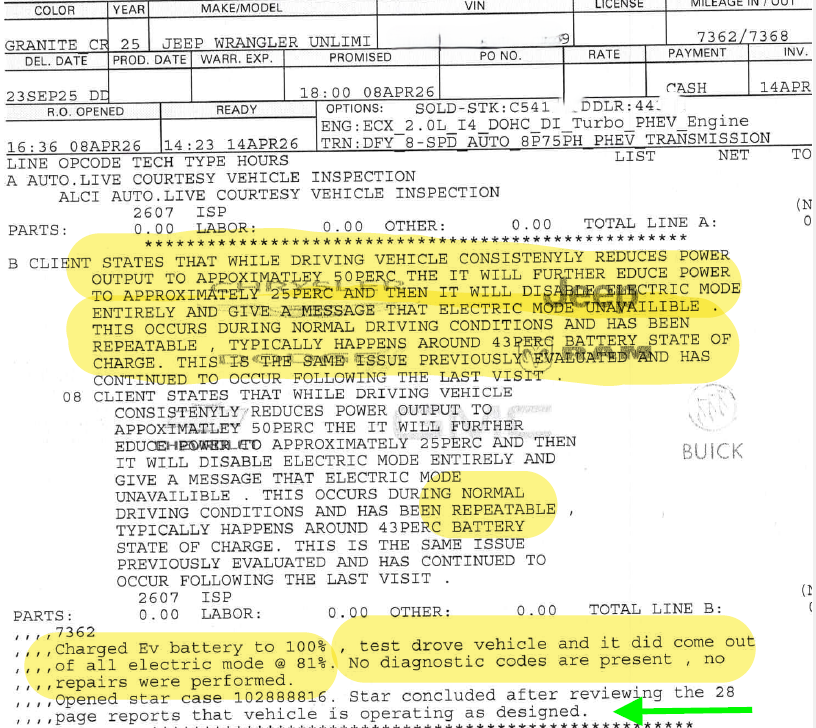
Repair order documenting the staged power reduction and a STAR case opened.
RECORD 1 · Client states the staged reduction to ~50% then ~25% with the "electric mode unavailable" message during normal driving; technician test-drove the vehicle, found no diagnostic codes, and opened a STAR case that concluded the vehicle is operating as designed.
Repair order documenting limp mode at 25% power and a test on a second vehicle from inventory.
RECORD 2 · Documents limp mode at ~25% power during electric driving and a test on a second 4xe from dealer inventory, which also came out of electric mode under the same test; STAR case referenced.
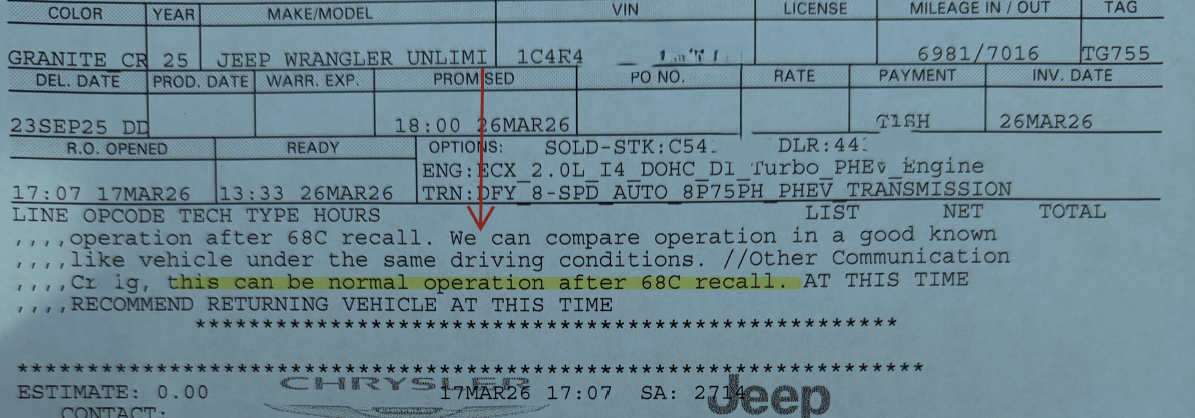
Service record with the engineering note that the behavior can be normal operation after the 68C recall.
RECORD 3 · Notes that the behavior "can be normal operation after the 68C recall," suggests comparing operation to a known-good like vehicle, and recommends returning the vehicle at this time.

Readout 03

A documented refusal to record findings

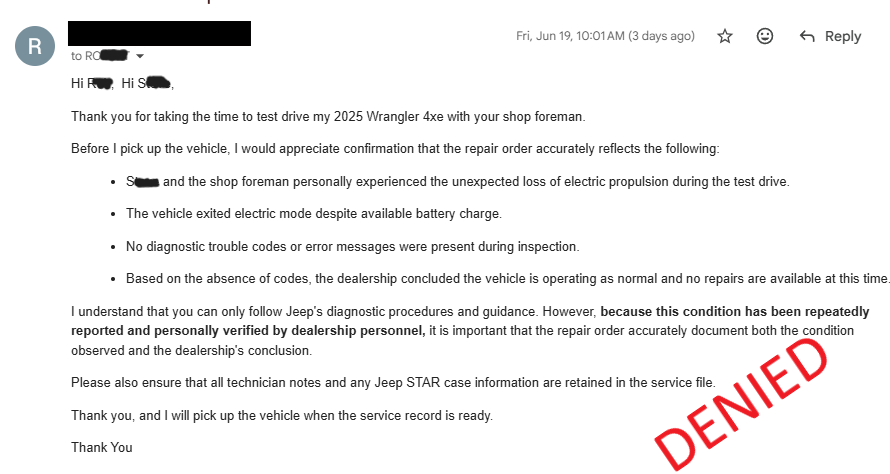
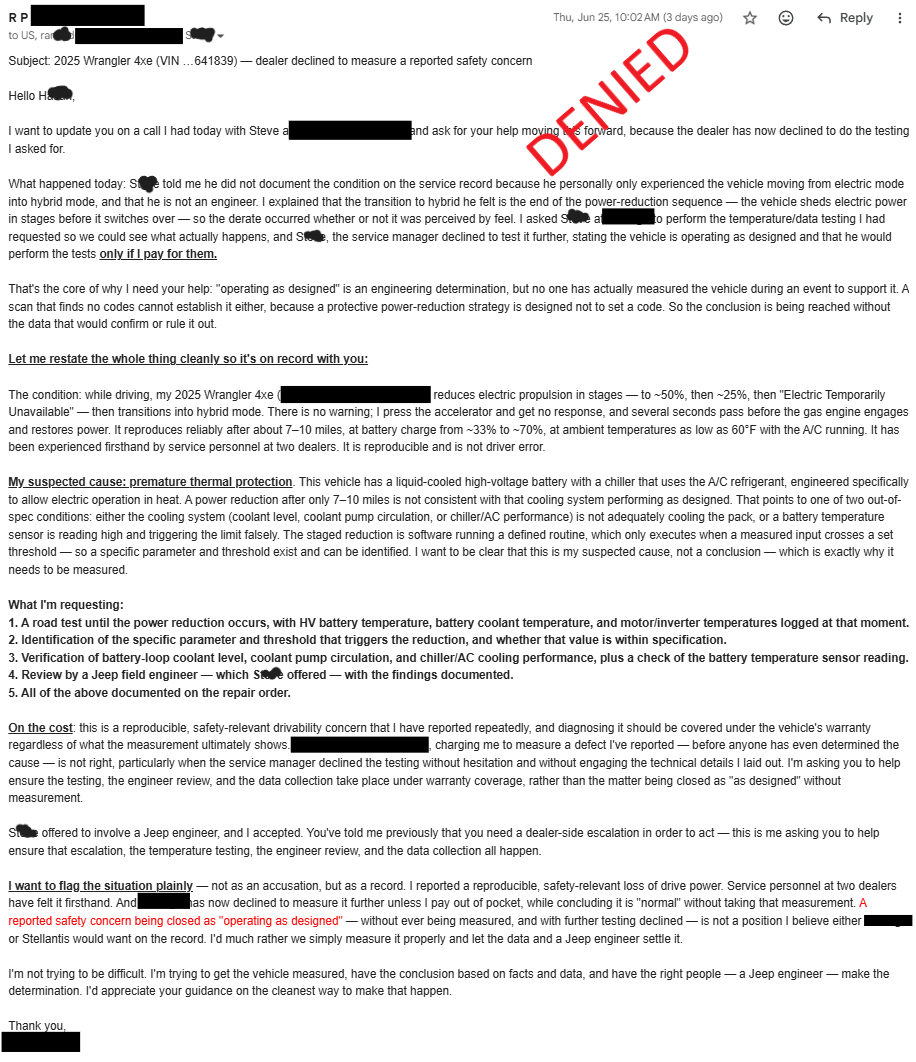
The owner asked, in writing, that the dealership's road-test findings be entered on the service report. The response is documented below.

Owner email asking that the repair order reflect that dealership personnel personally experienced the loss of electric propulsion on the test drive; marked declined.
The owner asked the service manager and service advisor to record their road-test findings on the service report. The service manager declined to put his and his foreman's road-test on the written record. He later stated by phone that he had experienced the vehicle's transition into hybrid mode, but would not update the repair order to reflect it.

A vehicle can only be repaired against what's written down. When findings stay off the repair order, the official record shows only "no codes, operating as designed" — even after the condition was experienced on a road test.

Readout 04

A documented refusal to measure

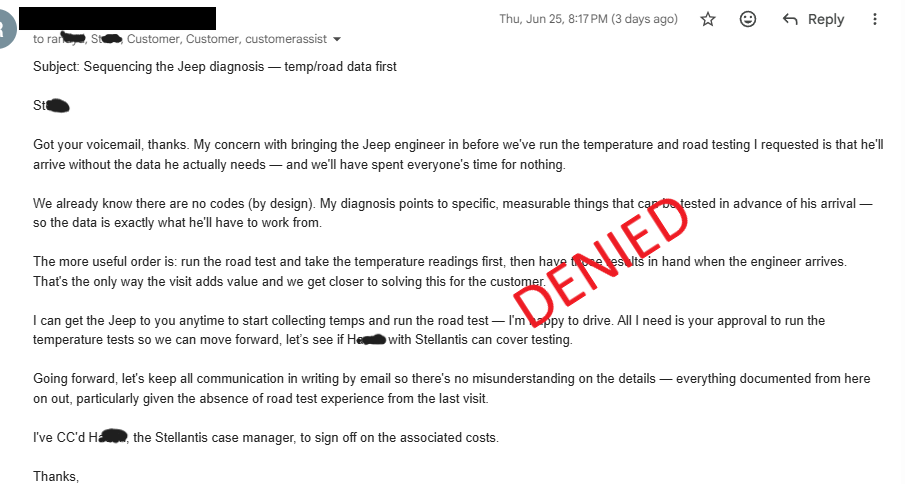
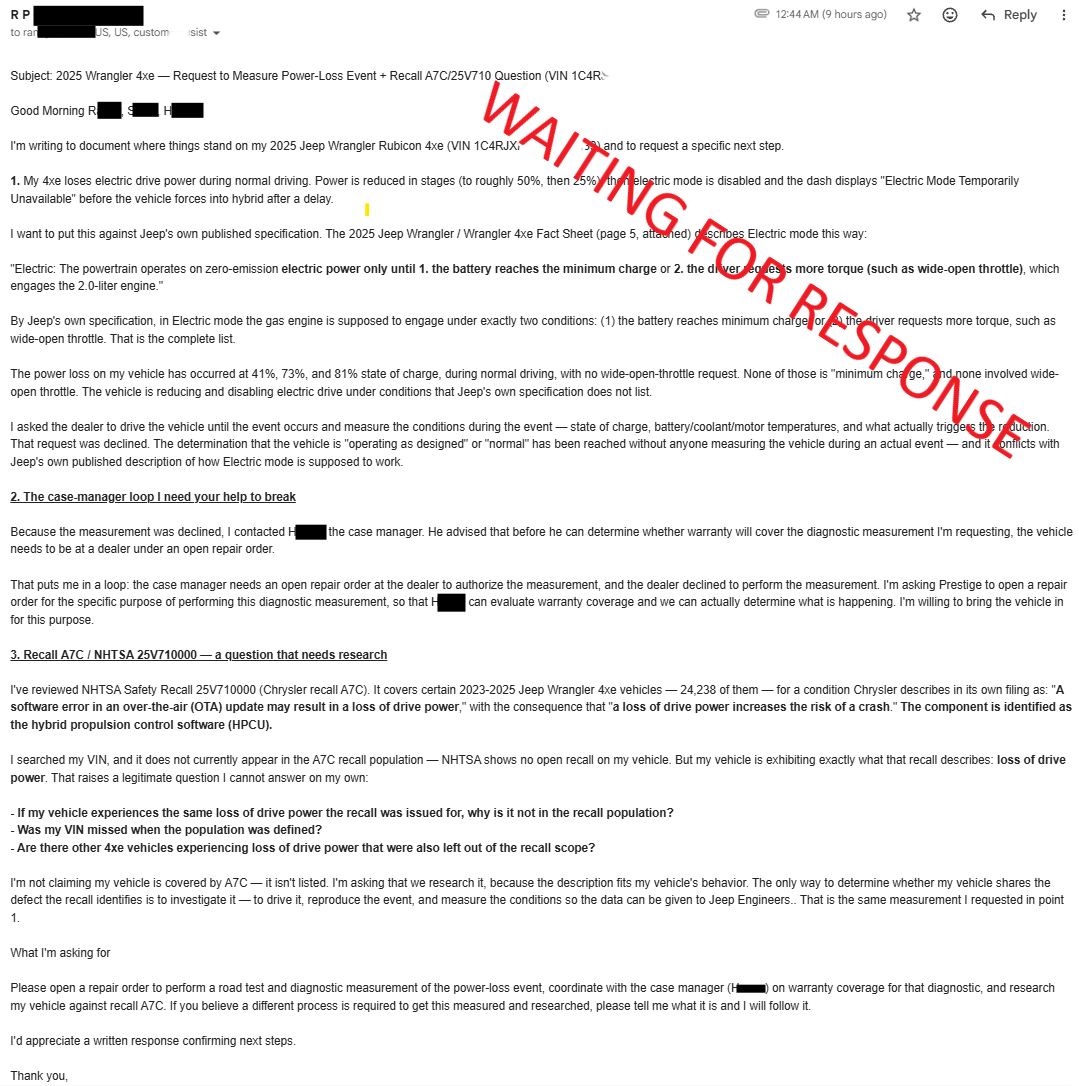
A second written request, on the same record — this one asking for measurements before a Jeep field engineer's visit.

Owner email requesting that battery, coolant, and motor temperatures be measured during the power-loss event before the Jeep field engineer's visit; marked declined.
After four service visits that each concluded "no codes, operating as designed," the dealer offered to involve a Jeep field engineer again. The owner asked that battery, coolant, and motor temperatures be measured during the power-loss event BEFORE the engineer's visit — so the engineer would have the diagnostic data in hand. The service manager declined to perform that testing.

This is the recurring pattern: the owner asked, in writing, for the specific measurements an engineer would need to evaluate the condition. The requests were made in writing; the responses came only by phone. The written record contains the owner's requests to measure and document the issue — and no written response agreeing to do so.

Readout 05

A request for cost coverage

The request then moved to the Stellantis case manager, to authorize the testing the dealer would only perform if paid for.

Owner email to the Stellantis case manager requesting authorization to cover the temperature testing; marked declined.
The owner asked the Stellantis case manager to authorize coverage for the temperature testing. The case manager responded that he could not consider it without an open dealer record / dealer-side escalation first, and made no commitment to cover the cost even then.

Sequence summary

The loop

The documented requests and responses, in order. Each step is recorded above.

  1. The owner asked the dealer to measure battery, coolant, and motor temperatures during the event. The dealer declined unless the owner paid out of pocket.
  2. The owner asked the Stellantis case manager to cover the cost of that testing. The case manager said he could not consider it without an open dealer record first — and made no commitment to pay.
  3. The dealer's position is that there are no codes, nothing is wrong, and there is nothing further they can do — and they will not perform the temperature measurements unless the owner pays.

Each party's requirement depends on the other. The result is that the one step everyone could agree on — measuring the vehicle during the event — has not been performed.

Readout 06

The owner escalates in writing

On June 29, 2026, this request was put in writing to the dealership's management and the manufacturer's case manager: open a repair order, drive the vehicle until the power-loss event occurs, measure the conditions, and research the vehicle against recall A7C. The request asks for a written response confirming next steps.

Email to Jeep dealer and case manager, June 29 2026, requesting diagnostic measurement of the 4xe power-loss event and research against NHTSA recall A7C.
Written request to the dealer (general manager and service manager) and the case manager, June 29, 2026 — asking that the power-loss event be measured during a road test and that the vehicle be researched against federal recall A7C. Personal details redacted.

The one record that doesn't depend on anyone agreeing.

This is the loop NHTSA exists to break. A federal safety complaint is the one record that does not depend on a dealer opening a case or a manufacturer agreeing to pay.

File your NHTSA complaint →

~10 min · free · the report regulators actually count